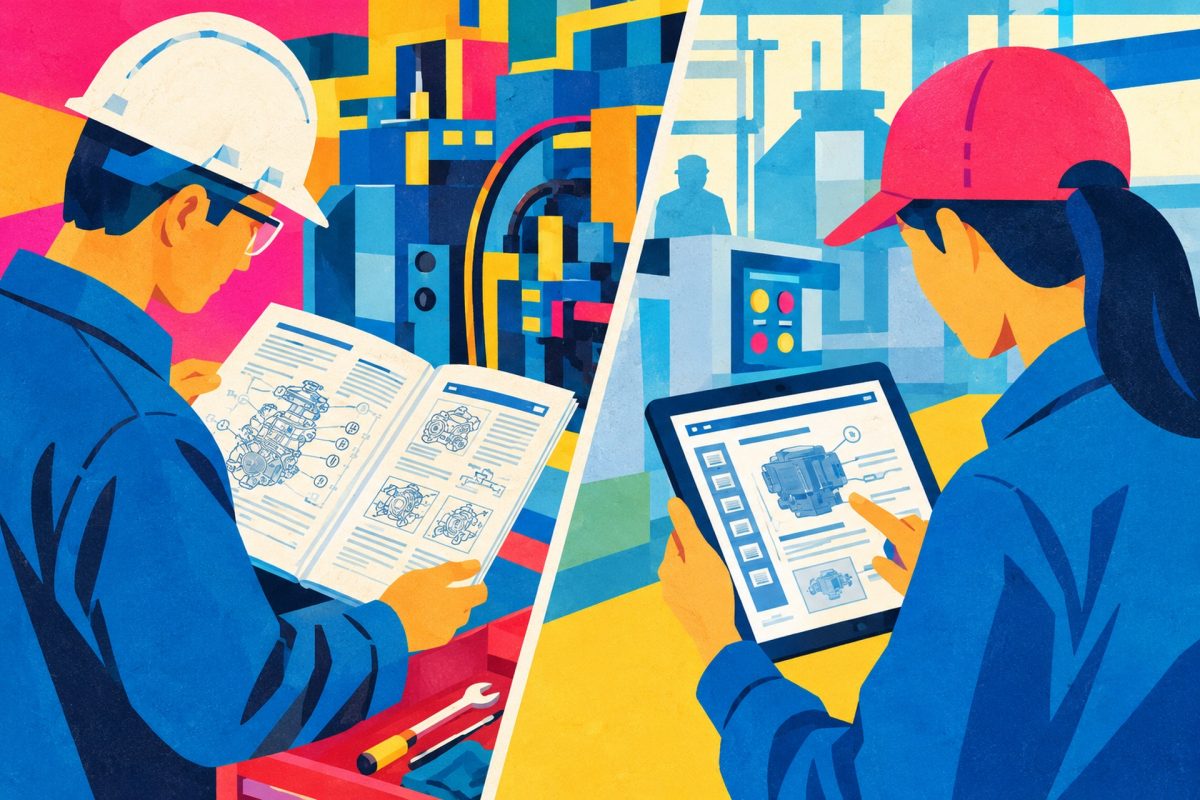
Key Takeaways:
・The Problem: 100% digital manuals fail in harsh, offline, or high-security field environments.
・The Solution: A hybrid approach combines single-source digital content with local, print-on-demand hard copies.
・The Benefit: Zero downtime for field technicians and zero wasted print inventory.
Going 100% digital for user guides, service manuals, and technical documentation creates unexpected costs and operational bottlenecks. While digital files offer quick searching and simple updates, physical manuals remain critical for harsh environments, offline job sites, and high-security zones.
Leading companies don’t choose between digital and paper; they use both. By keeping digital files updated online and printing hard copies locally only as needed, they give workers the fast access they want without wasting money on unused manuals.
What Is the “Digital-Only” Trap for Product Documentation?
The “Digital-Only” Trap occurs when a business completely stops printing manuals, user guides, and safety books to cut short-term costs. The business replaces physical documentation with digital PDFs, web portals, or mobile applications.
While business leaders often view digital delivery as an easy way to eliminate warehouse expenses, real-world field conditions tell a different story. In high-stakes industries, such as industrial manufacturing, medical devices, defense, and automotive, relying only on digital screens introduces expensive operational problems. When a complex machine breaks down, a frozen screen or a lost Wi-Fi connection causes immediate downtime.
Why Do Digital Manuals Fail in Critical Field Environments?
Digital keyword search works well in a quiet office environment. However, touchscreen screens frequently fail in tough field conditions due to three main operational limits:
・Harsh Working Conditions
Field technicians wearing heavy safety gloves or working with greasy hands cannot easily operate touchscreens. Direct sunlight also causes severe screen glare. A physical manual offers zero-latency navigation: it lies flat on a workbench, tolerates dirt, and operates without battery power.
・Connectivity and Security Gaps
Remote job sites, underground mines, and ocean ships often have no cellular or Wi-Fi signal. Furthermore, defense and advanced factories enforce air-gapped cybersecurity protocols that ban personal tablets or connected devices from the plant floor.
・Screen Size and Interface Problems
Complex maintenance requires viewing multi-page schematics and checklists at the same time. Small screens force technicians to constantly zoom, scroll, and switch tabs, while automatic screen timeouts interrupt hands-on work. Paper manuals allow wide-format diagrams to lie flat side-by-side without worrying about image displays or timeouts.
Why Do Traditional “Print-Only” Manuals Also Fall Short?
Does this mean you should go back to traditional paper manuals?
Not at all. Relying solely on printed binders creates serious business risks:
| The Paper Only Problem | What It Costs Your Business |
| Obsolescence | Updates happen constantly. Updating thousands of printed pages takes months and leaves teams using outdated, unsafe information. |
| Zero Searchability | Without digital indexing or Quick Search, technicians waste time flipping pages to find a single part number or detail. |
| Storage & Wasted Cash | Bulk printing forces you to store massive inventories. Unsold or updated stock turns into expensive trash. |
How to Implement a Hybrid Manual Strategy for Your Operations
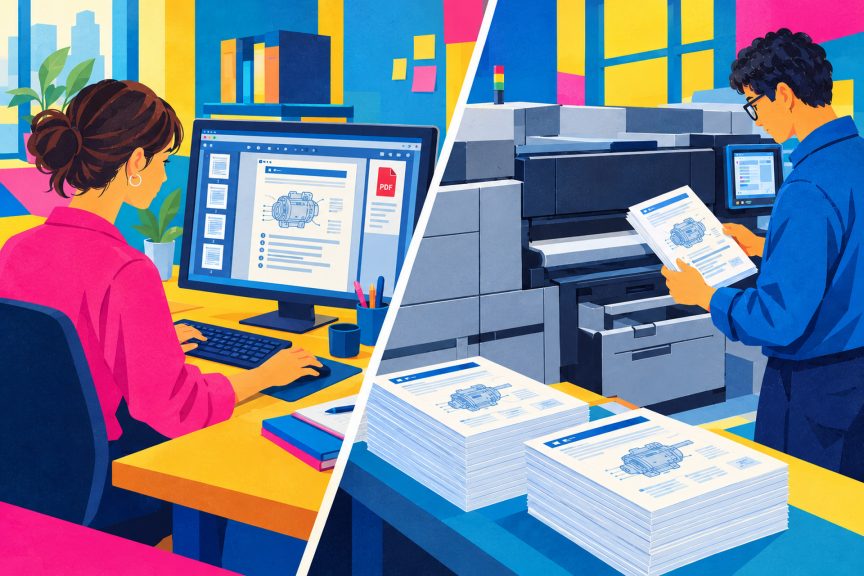
You don’t have to choose between going 100% digital or staying 100% paper. A smart hybrid approach connects both into one simple, efficient system. Instead of forcing one format on everyone, modern equipment documentation gives workers and technicians the exact tool they need, right when they need it:
・Smart Physical Manuals
Durable paper manuals placed directly on or near equipment include scannable QR codes. When technicians need deeper visual help, a quick scan with a phone or tablet opens 3D diagrams, parts lists, or video walkthroughs on the spot.
・One Master Digital Source
Technical teams write and manage content in a single central database. When updates are made, the system automatically refreshes both the online digital portal and the print-ready files at the exact same time.
・Local, Print-on-Demand
Instead of printing thousands of manuals centrally and paying to store them in warehouses, companies print copies locally only when an order or update requires it. This completely eliminates storage fees and eliminates wasted, outdated paper stock.
How Does Crestec USA Power the Modern Hybrid Workflow?
Navigating a hybrid documentation strategy requires a global partner that understands both technical writing and supply chain execution. Crestec USA provides single-source content management, global localization, and print-on-demand (POD) solutions for your technical documentation:
・Precision Translation & Localization
We ensure technical communications—from mobile app screens to printed manuals—are accurately translated, with specialized expertise in Asian and global markets.
・High-Precision Printing
We deliver high-quality offset and print-on-demand (POD) manuals and technical documents designed specifically for rugged field environments.
・Packaging Printing
We produce durable, cost-effective packaging solutions engineered to protect your manuals and products while reducing shipping weight and dimensional freight costs.
・Fulfillment Servies
We streamline manual logistics through agile print-on-demand production, quality checks, packaging, and local delivery across North America, Europe, and Asia.
Optimize Your Technical Communication Strategy Today
Contact Crestec USA today to build an agile, hybrid communication pipeline tailored to your global business goals.
FAQ
Q: Can we transition all of our manuals to digital-only formats?
A: You can, but the digital-only strategy can cause significant problems in harsh, offline, or high-security job sites and in situations where screens don’t work. The best strategy is a hybrid approach: instant digital access combined with field-ready printed manuals.
Q: Why do we need both physical and digital manuals?
A: Because digital and physical manuals solve entirely different problems. Digital formats make updating, searching, and accessing media like videos and 3D models fast and easy. However, physical manuals are non-negotiable on harsh job sites with no Wi-Fi, heavy gloves, bright sunlight, or high safety risks. Combining both gives you instant online searchability alongside 100% reliable, zero-downtime paper access in the field.